Microsoft Unveils ConferencePulse: .NET’s Composable AI Stack in Action
REDMOND, WA — Microsoft has revealed a new interactive conference assistant built entirely with its emerging composable AI stack for .NET. The app, called ConferencePulse, was demonstrated at the company’s internal MVP Summit and is designed to run live polls, answer audience questions in real time, generate insights from engagement data, and produce session summaries—all powered by a unified set of .NET libraries and frameworks.
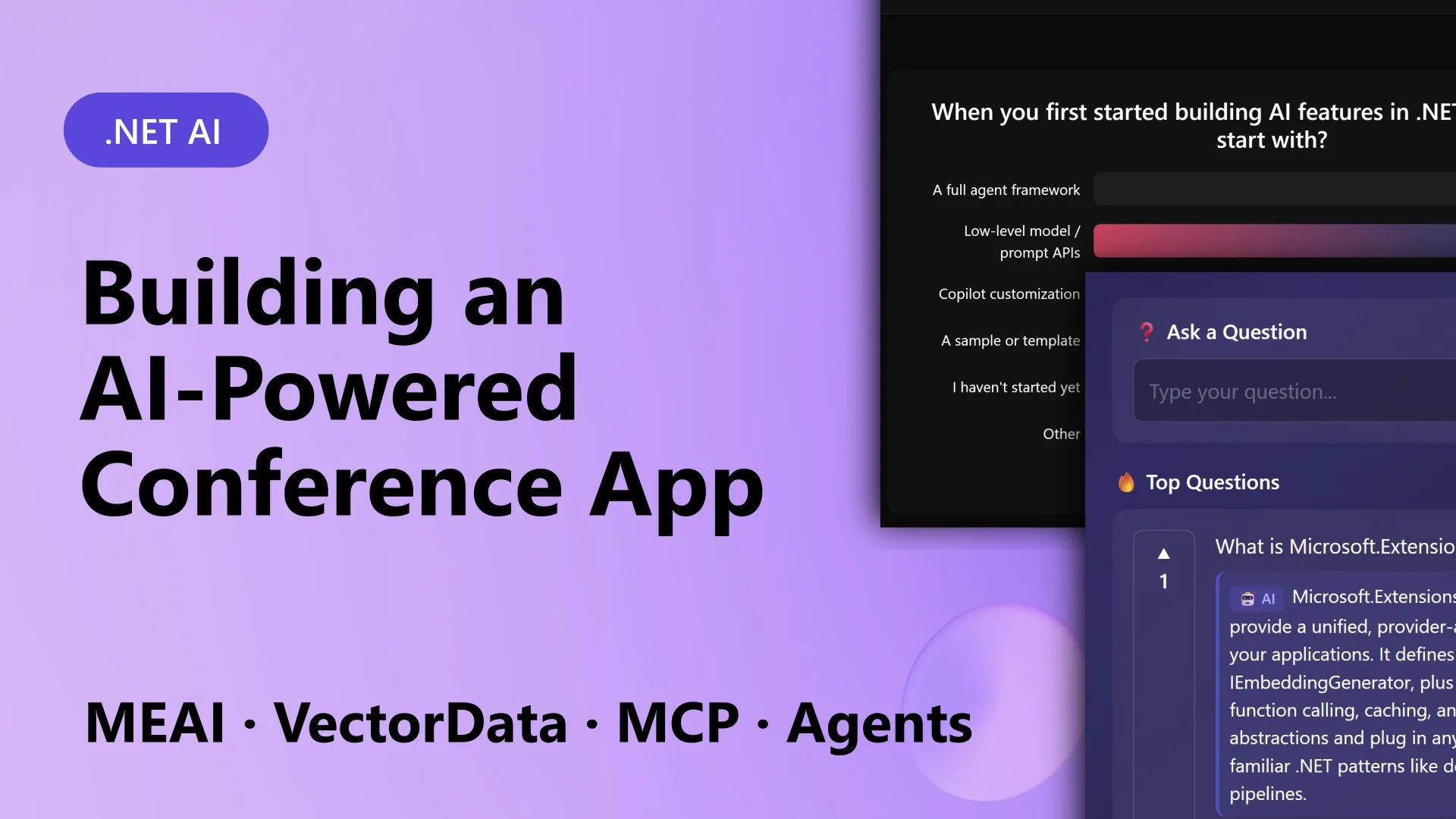
This is the first public walkthrough of how Microsoft’s Microsoft.Extensions.AI, Microsoft.Extensions.DataIngestion, Microsoft.Extensions.VectorData, Model Context Protocol (MCP), and Microsoft Agent Framework work together in a single application. Developers have long struggled with stitching together models, vector databases, ingestion pipelines, and agent frameworks from different ecosystems—each with its own patterns, client libraries, and versioning headaches. ConferencePulse proves a cleaner path exists.
The App That Practiced What It Preached
ConferencePulse is a Blazor Server application. Attendees scan a QR code to join a live session, then interact with the presenter by voting in AI-generated polls or submitting questions. On the backend, AI orchestrates multiple features:
- Live polls — Generated on the fly based on session content; results update in real time.
- Audience Q&A — The AI answers questions using a RAG (Retrieval-Augmented Generation) pipeline that pulls from session knowledge bases, Microsoft Learn docs, and GitHub wiki content.
- Auto-generated insights — Patterns in poll results and audience questions are surfaced as they arrive.
- Session summaries — When the presenter ends a session, multiple AI agents analyze polls, questions, and insights concurrently and merge their findings into a coherent wrap-up.
“We wanted an interactive session, not a slide deck. We wanted polls and audience insights. And we wanted to automate the preparation: point the app at a GitHub repo, and it downloads the markdown, processes it through a pipeline, and builds a searchable knowledge base,” the development team explained in a technical walkthrough. “Polls, talking points, and Q&A answers are all grounded in that content.”
Background: The Problem with Fragmented AI Tooling
For years, building AI features into .NET applications meant assembling components from different vendors: one library for embeddings, another for vector search, a third for agent orchestration. Each came with its own patterns, client libraries, and breaking changes. The result was costly integrations and brittle systems.
Microsoft’s response is a set of composable building blocks that provide stable abstractions across all these concerns. ConferencePulse runs on .NET 10, Blazor Server, and .NET Aspire. The source is organized into five projects covering the UI, core logic, data ingestion, agents, and MCP server/client—all orchestrated with Aspire.

The Composable AI Stack: How It Fits Together
Microsoft.Extensions.AI: One Interface for Any Provider
This library provides IChatClient, a unified abstraction that works with OpenAI, Azure OpenAI, Ollama, Foundry Local, and other providers. Every AI call in ConferencePulse goes through this single interface, making it trivial to switch or compare models without rewriting code.
“We can swap the underlying LLM with a single configuration change. That’s a huge productivity win for teams experimenting with different models,” the team noted.
Microsoft.Extensions.VectorData and DataIngestion
ConferencePulse downloads markdown from a GitHub repo, processes it through a pipeline (ingestion), and indexes it using vector search. The VectorData library abstracts away the underlying vector database—Qdrant in this case—so that queries and indexing logic remain provider-agnostic.
Model Context Protocol (MCP) and Agent Framework
MCP provides a standardized protocol for tools that AI agents can call. In ConferencePulse, MCP servers expose conference content, poll results, and Q&A logs. The Agent Framework orchestrates multiple agents that collaboratively analyze data for the session summary. “We treat the agents as independent workers that merge their findings—this mirrors how a team of humans would debrief,” the team said.
What This Means for .NET Developers
The ConferencePulse demo signals a strategic shift: Microsoft is serious about making AI development in .NET feel as native as building a web API. By offering unified abstractions for chat, vector search, ingestion, and agents, the company aims to eliminate the “glue code” that has plagued multi-service AI apps.
For enterprise developers, this could lower the barrier to adding sophisticated AI features—RAG, live polling, real-time insights—without locking into a single vendor. “We’re not just showing off a tech demo; we’re showing a repeatable pattern that any .NET team can adopt,” the team emphasized.
The codebase is available as a reference architecture, and the libraries are being released as NuGet packages. Early adopters can expect more documentation and tooling support as the stack matures.
— Reporting by the .NET AI engineering team