Quick Facts
- Category: Cybersecurity
- Published: 2026-05-10 08:00:58
- Anthropic Launches Claude Opus 4.7 on Amazon Bedrock: Next-Gen AI for Enterprise Coding and Agents
- 8 Essential Insights into Local-First Web Development
- Samsung Galaxy S26 Ultra Hits Unprecedented $300 Discount on Amazon – Analysts Call It a Must-Buy
- Ubuntu Trims Official Flavor Lineup: ‘Fewer Choices, More Clarity’ Say Developers
- How to Navigate FDA Approval for an Alzheimer’s Agitation Therapy
Platform teams managing Kubernetes often discover a massive security gap when scaling environments: reliably managing secrets without slowing down development. Even with enterprise platforms like Red Hat OpenShift, the underlying Kubernetes secrets are not designed for enterprise governance. As environments grow across clusters and clouds, the challenge shifts from getting a secret into a pod to managing the entire lifecycle—generation, injection, rotation, revocation. With Vault as the standard for centralized secrets management, teams need a pattern that standardizes delivery and automation in Kubernetes. This article demystifies the top seven integration methods, highlighting tradeoffs and why the Vault Secrets Operator (VSO) is now the recommended approach for modern deployments.
1. Recognize the Limitations of Native Kubernetes Secrets
Kubernetes offers native Secrets, but they are not built for enterprise governance. They are stored in base64 (not encrypted at rest without extra configuration), lack fine-grained access controls, and do not support automated rotation or revocation. As cluster count grows, managing secrets natively becomes a sprawl problem—each secret is static, versioned poorly, and often copied across namespaces. Furthermore, most secrets are used outside Kubernetes (e.g., API keys, database credentials), so a pod-specific secret store is insufficient. The Vault Secrets Operator (VSO) addresses these gaps by integrating with Vault's centralized lifecycle management, but first it's crucial to understand why native Secrets alone fall short for enterprise security and compliance.
2. Leverage the Vault Agent Sidecar Injector for Dynamic Injection
The Vault Agent Sidecar Injector was historically the go-to solution. It uses a mutating webhook to inject a Vault agent sidecar into pods, which authenticates with Vault, fetches secrets, and writes them to a shared volume. This method supports dynamic secrets and automatic renewal. However, it introduces operational complexity: you must manage sidecar injection configuration, the agent consumes pod resources, and secret updates require pod restarts. It's also less Kubernetes-native because the secret is not represented as a native resource. For teams already invested in sidecar patterns, this works, but the newer Vault Secrets Operator offers a more streamlined, Kubernetes-aware approach with lower overhead.
3. Utilize the Secrets Store CSI Driver for Standardized Mounting
The Secrets Store Container Storage Interface (CSI) driver provides a standardized way to mount secrets from external stores like Vault into pods as volumes. It decouples secret retrieval from application logic and works with any CSI-compliant storage provider. The driver can sync secrets to native Kubernetes Secrets for workloads that rely on them, and it supports rotation without pod restarts. However, it adds a separate CSI component to the cluster, requires driver configuration per secret, and lacks the Vault operator's lifecycle visibility. For teams wanting a vendor-agnostic interface, the CSI driver is solid, but VSO's Protected Secrets feature builds on this with tighter Vault integration.
4. Adopt the Vault Secrets Operator (VSO) for Kubernetes-Native Control
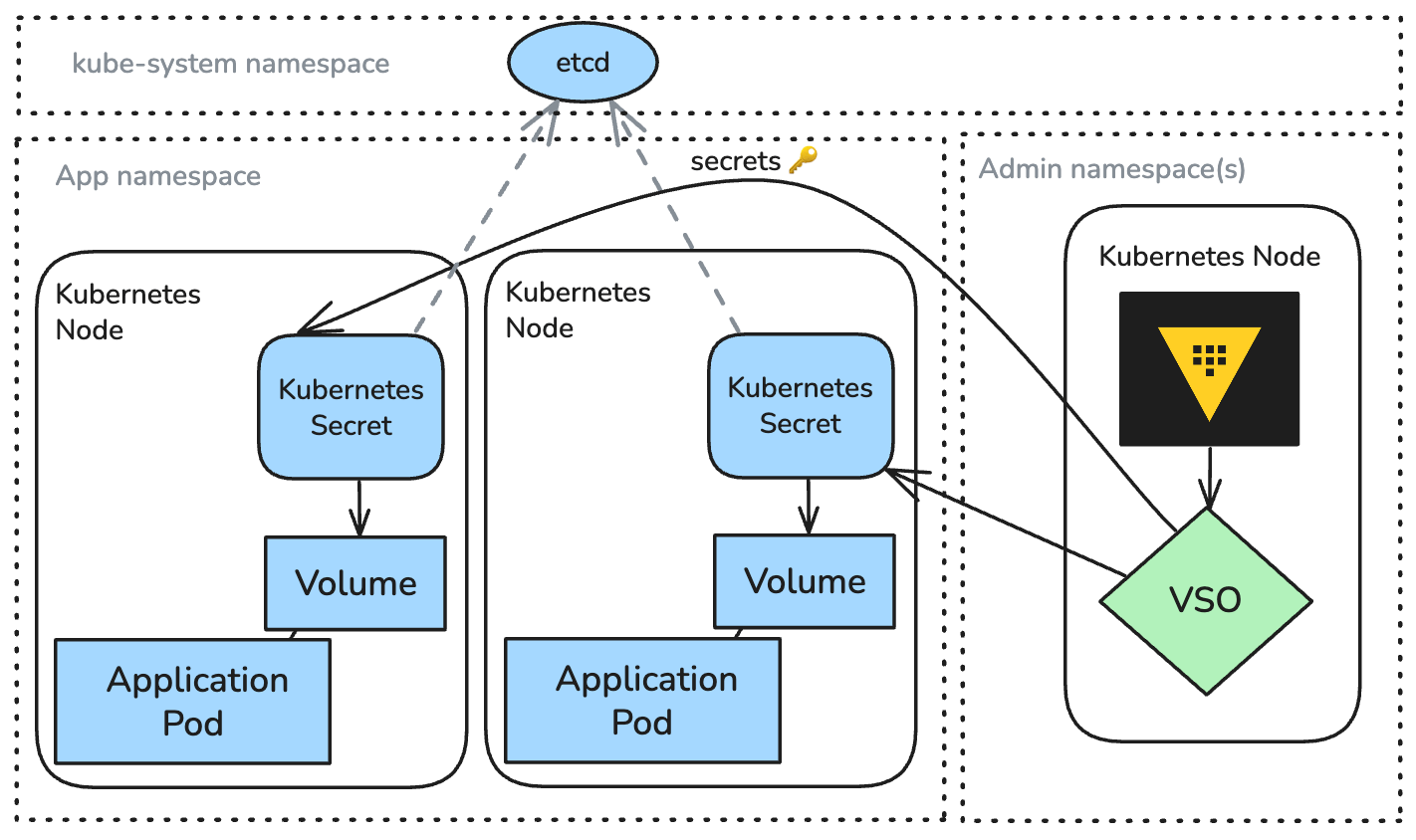
The Vault Secrets Operator, developed in partnership between HashiCorp and Red Hat (IBM), is a Kubernetes operator that manages the full lifecycle of secrets from Vault. It introduces custom resource definitions (CRDs) like VaultSecret and VaultAuth, allowing you to define secrets as Kubernetes resources. The operator watches for changes and automatically syncs secrets from Vault to native Kubernetes Secrets. It supports static and dynamic secrets, rotation without pod restarts, and integrates with Vault policies. VSO is Kubernetes-native, reduces manual configuration, and does not require sidecars. It is the recommended standard for most use cases because it combines the security of Vault with the simplicity of Kubernetes controllers.
5. Explore VSO Protected Secrets with Built-in CSI Driver
For scenarios requiring even tighter security, VSO offers Protected Secrets, which uses a built-in CSI driver to avoid storing secrets in etcd at all. Instead of syncing to a native Secret, VSO mounts the secret directly from Vault into the pod's filesystem via a CSI volume. This eliminates the risk of etcd compromise exposing secrets. The feature is ideal for compliance-heavy environments where secrets must never be persisted in the Kubernetes data store. It retains all VSO benefits like automatic updates and lifecycle management, but with an additional CSI layer. Teams can choose between the standard VSO sync or Protected Secrets based on their threat model.
6. Evaluate Third-Party Secrets Operators
Several third-party operators exist for bridging Vault and Kubernetes, such as those from external vendors or open-source projects. While they offer alternative approaches, they come with tradeoffs: lack of official HashiCorp support, potential lag behind Vault API changes, and varying maturity. Some may provide features like cross-cluster replication or unique authentication methods, but they often duplicate effort with the official VSO. For enterprises that rely on HashiCorp's enterprise support and lifecycle alignment, the official VSO is safer. However, if you need a specialized feature not in VSO, a third-party operator could fill that gap—but be prepared for integration maintenance and testing.
7. Follow Best Practices: Choose VSO for Most Use Cases
After evaluating all methods, the Vault Secrets Operator emerges as the recommended standard for modern Kubernetes and OpenShift environments. It provides a Kubernetes-native experience (CRDs, controllers), supports both static and dynamic secrets, and offers flexibility with standard sync or Protected Secrets for enhanced security. VSO does not change how pods consume secrets—they still use native Kubernetes Secrets or CSI mounts—so developers need not modify their applications. Combine VSO with Vault's identity-based access and rotation policies for a robust, scalable solution. For most teams, VSO strikes the best balance between simplicity, security, and lifecycle automation.
In conclusion, automating secret lifecycle management in Kubernetes requires a deliberate choice among integration patterns. Native Secrets lack enterprise governance; sidecar injectors and CSI drivers add complexity; third-party operators introduce risk. The Vault Secrets Operator, especially with Protected Secrets, delivers a comprehensive, Kubernetes-native solution that aligns with modern DevOps practices. Assess your cluster scale, compliance needs, and team expertise, and adopt VSO as the foundation for your secret management strategy—ensuring security without stunting developer velocity.